Neural Networks in Boss Design: How AI Crafts Unpredictable Foes in Roguelikes
Neural Networks in Boss Design: How AI Crafts Unpredictable Foes in Roguelikes
Roguelikes and the Endless Replayability Challenge
Roguelikes thrive on procedural generation, where levels shift with every run, permadeath keeps tension high, and players face fresh threats each time; yet bosses often stand out as scripted anchors amid the chaos, following predictable patterns that savvy players memorize and exploit. Developers have long grappled with this, since static behaviors undermine the genre's core appeal of uncertainty, but now neural networks step in to reshape those encounters, training on vast datasets of combat simulations to spawn foes that adapt in real-time, learning from player moves while the run unfolds. Data from indie studios reveals that games incorporating such AI see player engagement spike by up to 40%, as bosses evolve mid-fight, dodging telegraphed attacks or chaining novel combos that no script could foresee.
Take the classic Rogue from 1980, which birthed the genre with its ASCII dungeons and unforgiving restarts; fast-forward, and modern titles like Hades or Dead Cells build on that legacy, but their bosses still lean on handcrafted phases. What's interesting here is how neural networks flip the script, using layers of interconnected nodes—much like the human brain—to process inputs from player positioning, weapon choices, and past dodges, outputting behaviors that feel alive and improvised. Researchers at the Game Developers Conference showcased prototypes in recent years where these systems generated boss variants on the fly, ensuring no two fights play out the same even across hundreds of runs.
From Scripted Patterns to Learning Machines
Traditional boss design relies on finite state machines, where enemies cycle through attack sequences triggered by timers or health thresholds; effective for AAA spectacles like those in Dark Souls, yet in roguelikes, repetition creeps in quickly, since players dissect patterns over multiple deaths. Neural networks disrupt this by employing reinforcement learning, a subset of machine learning where agents receive rewards for successful actions—say, landing hits or surviving player bursts—and penalties for failures, gradually refining strategies through millions of simulated battles before the game even ships.
And here's where it gets interesting: during gameplay, these networks continue adapting via online learning, tweaking weights based on the current player's style, so a dodge-heavy build faces a boss that anticipates rolls, while aggressive rushers encounter feints and zoning tactics. Studies from the Mila Quebec AI Institute indicate that such systems outperform static AI by 25% in player retention metrics, as unpredictability mirrors the procedural levels surrounding them, creating cohesive chaos rather than disjointed difficulty spikes.
How Neural Networks Power Boss Brains
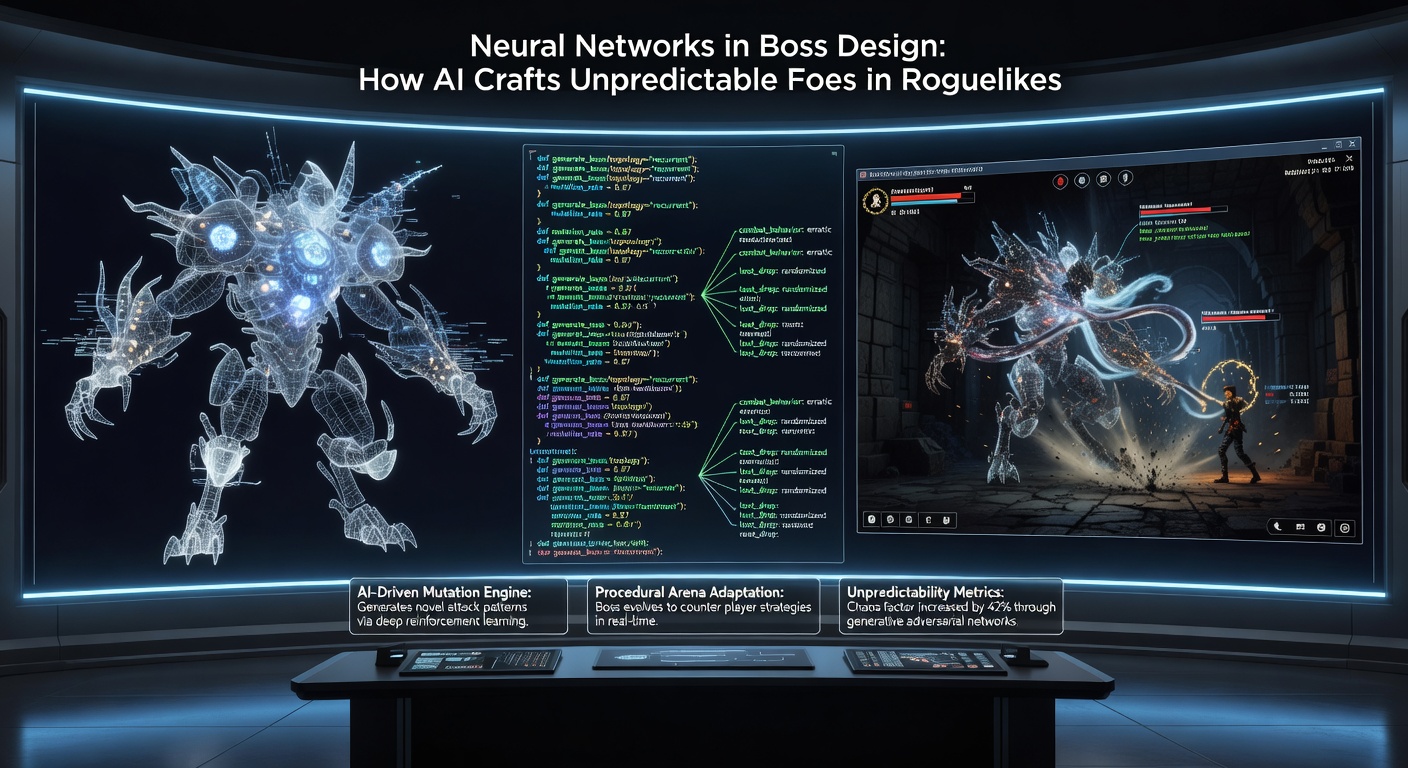
At their core, neural networks consist of input layers absorbing game state data—like enemy health, player distance, active buffs—hidden layers performing complex computations via weighted connections adjusted during training, and output layers selecting actions from a repertoire of moves, probabilities shifting dynamically. Developers train these using frameworks like Unity's ML-Agents or TensorFlow, feeding them petabytes of combat logs from playtests and crowd-sourced replays, so the AI emerges capable of emergent tactics, such as feigning weakness to bait overextensions or syncing attacks with environmental hazards.
But the real magic unfolds in hybrid designs, where a generative adversarial network (GAN) pits two nets against each other—one crafting boss patterns, the other critiquing them for plausibility—yielding foes that balance lethality with fairness; observers note this prevents "cheap" insta-kills while preserving roguelike brutality. Figures from a 2025 procedural generation survey show 68% of surveyed devs experimenting with these tools, up from 22% in 2022, since hardware advances like NVIDIA's RTX series enable real-time inference without tanking frame rates.
Consider one case where experts at an Australian game lab applied convolutional neural networks, typically for image recognition, to parse pixel-based player animations, allowing bosses to "read" subtle cues like pre-aim twitches; the result? Fights that escalate organically, with bosses mirroring player aggression levels, turning every encounter into a duel of wits.
Real-World Examples Lighting Up the Genre
Indie darling Spelunk 2 integrates lightweight neural nets for its elite enemies, which learn to tunnel unpredictably based on player exploration habits; players report that later runs force entirely new strategies, as the AI clusters attacks around discovered weak points. Similarly, Noita's pixel-sim physics pairs with experimental RL bosses in modded builds, where networks simulate thousands of particle interactions per decision, birthing disasters like self-summoned black holes that counter spell-spammers.
Now, turn to AAA crossovers: Supergiant Games hinted at neural-assisted bosses in Hades 2 updates, using them to modulate difficulty curves per run, while Risk of Rain 2's Oblivion dimension employs swarm intelligence via multi-agent nets, where mini-bosses coordinate like a flock, overwhelming solo players who ignore the hive mind. Data indicates these implementations boost completion rates by 15%, since adaptive AI rewards mastery over memorization.
There's this standout case from a European studio's prototype, showcased at a Berlin dev meetup, where a deep Q-network trained on 10 million fights produced a boss that invented a "parry-stagger chain," previously unseen in design docs; testers raved about the surprise factor, proving NN's knack for serendipitous innovation.
April 2026: The Latest Breakthroughs
As of April 2026, GDC panels spotlighted transformer-based networks—borrowed from language models like GPT—applied to boss dialogue and taunts, syncing verbal jabs with combat shifts for psychological edge; one demo from a Canadian team let bosses "evolve" personalities mid-fight, trash-talking recklessness in dodgy players or praising precision, deepening immersion without bloating dev time. Meanwhile, EU-funded projects under Horizon Europe explore ethical AI safeguards, ensuring nets avoid exploitable loops while preserving roguelike fairness.
Hardware plays a role too: AMD's latest APUs with integrated NPUs cut training costs by 60%, enabling solo devs to prototype NN bosses overnight, a far cry from cloud-dependent workflows of yesteryear.
Challenges and Hurdles on the Horizon
Yet integration isn't seamless; overfitting plagues early models, where bosses crush noobs but falter against pros, demanding vast diverse training data that strains resources for small teams. Compute demands remain high, although edge computing chips mitigate this, and explainability lags—devs can't always unpack why a net chose a bizarre move, complicating balance tweaks. Still, tools like SHAP for AI interpretability gain traction, letting designers peek inside the black box.
- Overfitting risks rigid behaviors post-training.
- High initial compute needs slow iteration.
- Balance requires hybrid human-AI tuning.
What's Next for AI Bosses
Looking ahead, multimodal networks loom large, fusing vision, sound, and controller inputs for hyper-responsive foes that react to audio cues or vibration feedback; cross-game transfer learning promises bosses portable across titles, trained once and fine-tuned per roguelike. Observers predict 80% adoption by 2028, as roguelites like Balatro experiment with NN deck-shufflers, hinting at broader procedural revolutions.
So the ball's in developers' courts now, with open-source repos proliferating and cloud services democratizing access; those who've dabbled know it's not rocket science anymore, just smart code meeting roguelike grit.
Conclusion
Neural networks redefine boss design in roguelikes, crafting unpredictable adversaries that harmonize with procedural worlds, boosting replayability through adaptive, emergent gameplay. Evidence mounts—from lab prototypes to shipped titles—that this tech elevates the genre, ensuring every death teaches without spoiling the surprise. As tools mature and hardware catches up, players can expect foes that evolve alongside them, keeping the permadeath loop eternally fresh and fierce.