How Trophy and Achievement Rarity Statistics Guide Players Toward Hidden Narrative Layers in Post-Launch Updated Console Exclusives
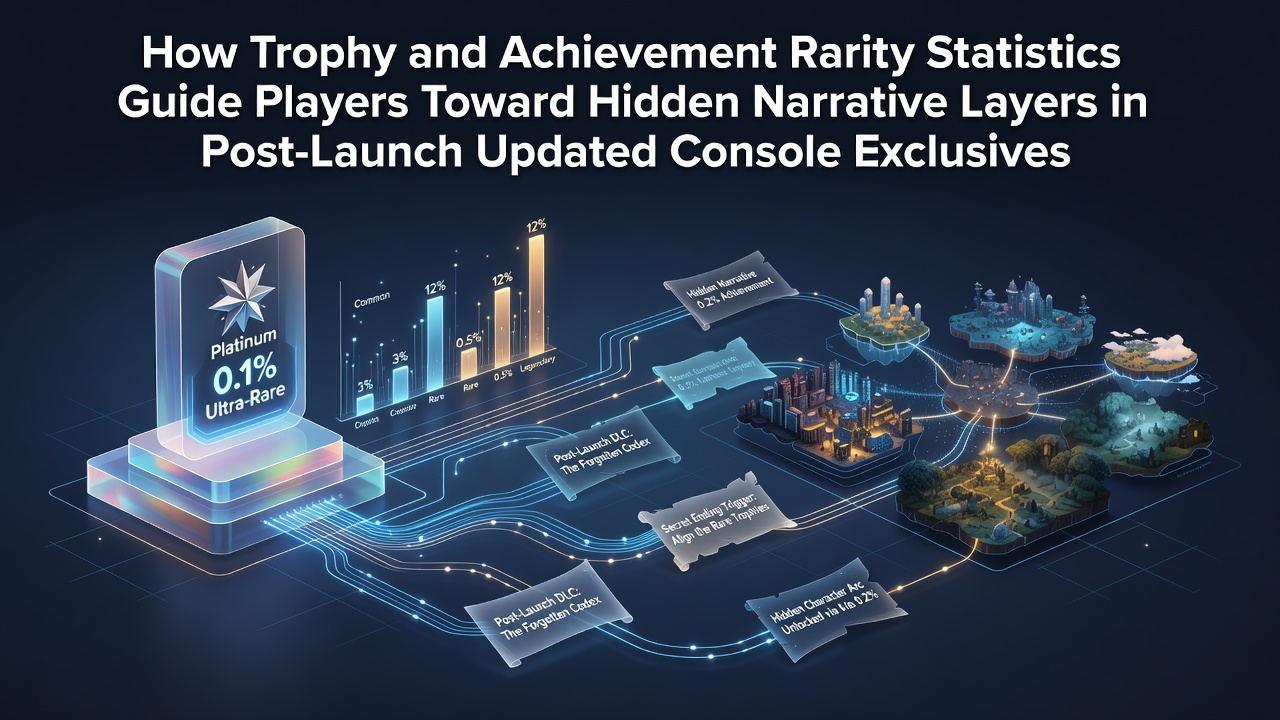
Console exclusives that receive post-launch content updates often embed additional story elements behind achievements and trophies with notably low completion rates, and players have learned to consult public rarity statistics as reliable indicators for locating these layers. Data from platform leaderboards shows that trophies falling below 5 percent completion frequently correspond to optional narrative branches introduced in patches released months after initial launch, allowing developers to expand lore without altering core mechanics for all users.
Tracking Rarity as a Navigation Tool
Public trophy systems on PlayStation and Xbox networks publish completion percentages updated daily, and observers note that these figures remain stable for standard progression items yet drop sharply when tied to hidden content added through free title updates. In June 2026 several major console exclusives incorporated new story arcs via seasonal patches, and analysts at the Entertainment Software Association reported that community forums saw increased activity around low-percentage trophies within days of each update rollout. Players cross-reference these statistics with patch notes to isolate which achievements require exploration of revised environments or dialogue trees that were not present at launch.
Patterns in Post-Launch Content Delivery
Developers frequently attach rare trophies to narrative extensions that appear only after certain conditions are met in updated versions, and this approach preserves surprise for returning players while providing measurable engagement metrics. Research compiled by the European Games Developer Federation indicates that such trophies exhibit completion rates between 1 and 3 percent in the first quarter after patch deployment, compared with 40 to 60 percent for trophies earned during the main campaign. The disparity creates a clear signal that directs attention toward specific regions or character interactions that contain supplementary plot details.
One documented case involved an open-world exclusive where a trophy linked to an alternate ending sequence maintained a 2.1 percent rarity six months after the relevant update, prompting widespread discussion on dedicated data-tracking sites. Players who followed the rarity cue discovered new voice lines and environmental storytelling assets that connected previously separate quest lines into a cohesive subplot. Similar patterns emerged in other titles where post-launch patches introduced collectible lore items, each accompanied by a trophy whose rarity hovered below the 4 percent threshold.
Integration with Community Data Platforms
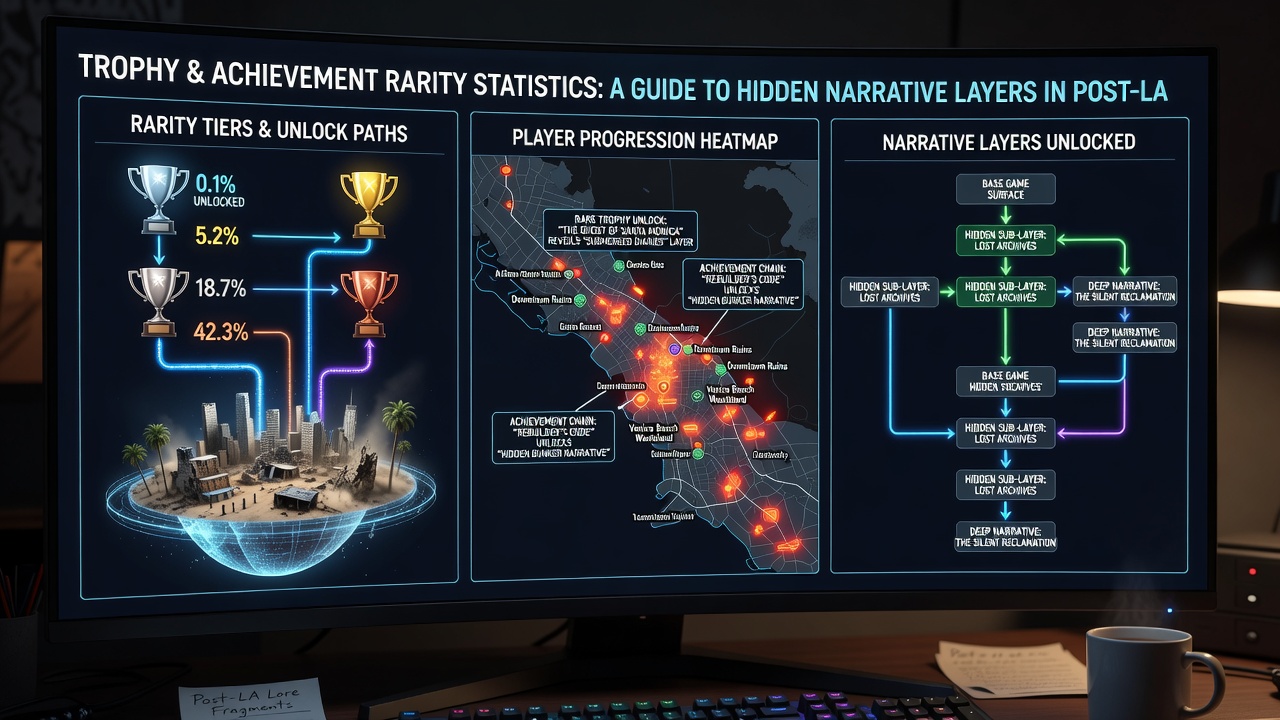
Third-party websites aggregate trophy data across thousands of accounts and allow filtering by rarity, platform, and patch version, which accelerates identification of narrative-related unlocks. According to figures released by the Interactive Software Federation of Asia-Pacific, monthly active users of these aggregation tools increased by 18 percent in early 2026, coinciding with a wave of console exclusive expansions. The tools display historical rarity trends, revealing when a trophy's completion rate stabilized after an update and thereby confirming its connection to optional story content rather than standard progression.
Players combine these visualizations with in-game map changes introduced in patches to locate new areas that house the required actions. This method reduces trial-and-error time and focuses effort on sections of the game world that received the most substantial post-launch modifications. Data from multiple titles demonstrates that trophies attached to narrative extensions maintain lower rarity for longer periods than those tied to mechanical challenges, because story content often demands specific sequencing or repeated playthroughs.
Developer Use of Rarity Feedback
Studio telemetry teams monitor trophy rarity as one indicator of how effectively new narrative layers reach the player base, and they adjust future patches based on these engagement signals. When rarity remains unexpectedly high for a story-focused trophy, developers sometimes release supplementary guidance through in-game journals or social media posts that point toward the required sequence without spoiling the content itself. This feedback loop has become standard practice for console exclusive franchises that rely on ongoing updates to sustain interest over multiple years.
Conclusion
Rarity statistics function as an external index that highlights which post-launch additions contain meaningful narrative extensions, and the practice has become embedded in how communities approach updated console exclusives. Platform data continues to show consistent correlations between low completion percentages and optional story branches, while aggregation tools and developer monitoring reinforce the utility of these metrics for locating hidden layers. As update cycles extend the lifespan of exclusive titles, the relationship between trophy rarity and narrative discovery remains a reliable constant across platforms.