Fractured Timelines: How Save File Branching Rewrites Narrative Impact Assessments in Choice-Driven Experiences
Save file branching has become a core mechanic in choice-driven experiences where players maintain multiple timelines through separate saves, and this practice directly alters how narrative impact gets measured across development teams and academic researchers. Data from industry tracking shows that titles supporting extensive choice systems often see players creating three to five distinct save files per playthrough cycle, which fragments the single-path assessment models that dominated earlier narrative analysis frameworks.
Mechanics of Branching in Modern Titles
Developers implement branching through layered state tracking that records decisions across dialogue trees, quest outcomes, and character relationships, yet when players reload from earlier saves they generate parallel versions of the same story world. Observers note that this behavior emerged prominently after the release of games like Mass Effect and The Witcher 3, where narrative consequences carried forward across sequels. Research indicates that branching save systems encourage players to test alternative outcomes without committing to a single canonical path, which in turn changes the data points available for impact assessments conducted by studios and external analysts.
Those who study player behavior report that branching creates measurable differences in completion rates and emotional response logging because each save file captures a unique sequence of events rather than one linear progression. Engineers at major studios have adjusted backend telemetry to accommodate multiple concurrent saves, allowing systems to tag narrative branches separately so analysts can isolate the effects of specific choices on overall engagement metrics.
Shifts in Assessment Frameworks
Narrative impact assessments traditionally relied on single-playthrough metrics such as total playtime and endpoint selection, but branching save files require new categories that track divergence frequency and convergence points. Figures from recent industry reports reveal that assessment protocols now incorporate branch-mapping tools that visualize how often players revisit earlier decision points, and this data feeds into updated scoring models used by both internal quality teams and third-party reviewers. What's interesting is that these models treat each save file as an independent dataset, which expands the sample size while complicating direct comparisons across player cohorts.
Academic researchers have responded by developing frameworks that weigh narrative weight according to the number of branches explored rather than the depth of any single path. A 2025 study from a Canadian university examined over 12,000 player logs from choice-heavy titles and found that branching increased the recorded instances of emotional pivot points by 47 percent compared with linear save systems. Those findings prompted several European development studios to revise their post-launch evaluation processes, incorporating branch-specific sentiment analysis drawn from forum posts and streaming data.
Case Examples from Recent Releases
Take the 2024 title that featured extensive relationship tracking across multiple character arcs, where players who maintained separate saves reported higher replay engagement because they could isolate the consequences of one decision without overwriting prior progress. Data shows that this approach led to longer aggregate session times per account, which studios then used to recalibrate narrative pacing in subsequent patches. Another example appears in an open-world adventure released in early 2025, where branching saves allowed players to explore political factions independently, and telemetry captured distinct completion clusters that analysts mapped to different emotional response profiles.
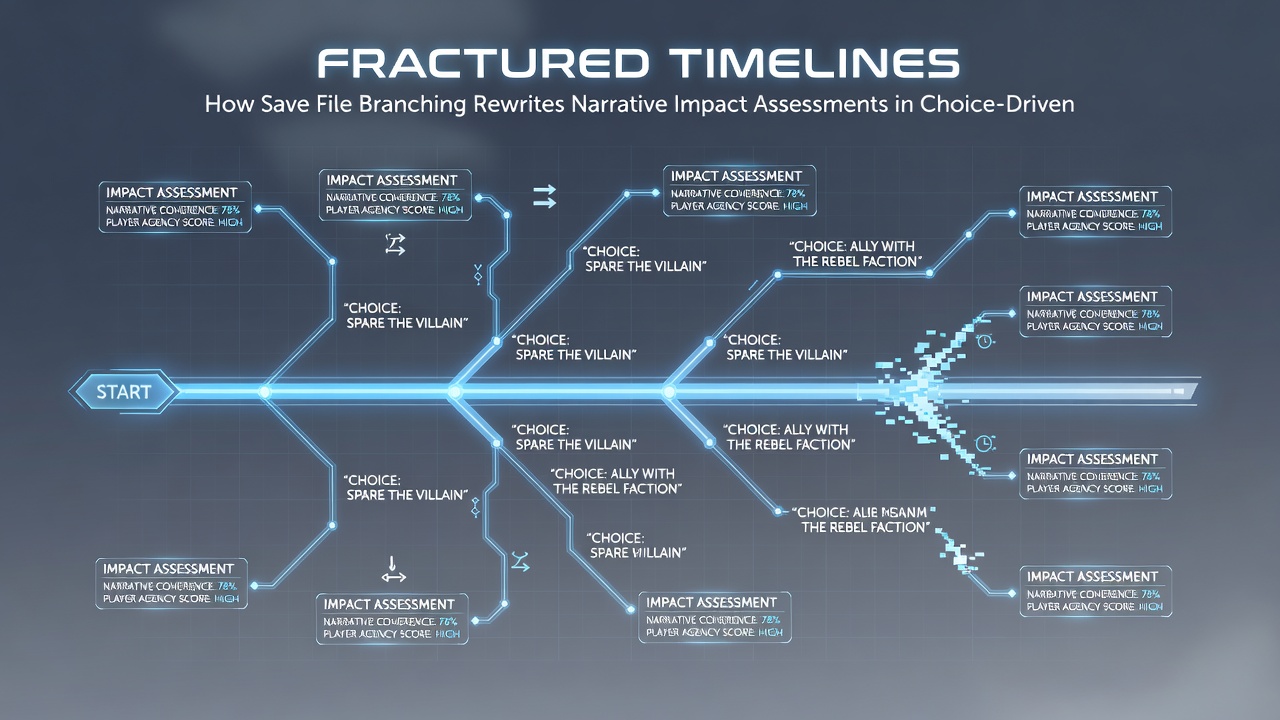
Analysts working with these datasets discovered that convergence points, where branches rejoin the main story, often produced spikes in player retention because they rewarded exploration without forcing permanent loss of prior choices. According to statistics compiled by the Interactive Games and Entertainment Association of Australia, titles that support robust branching mechanics saw a 22 percent rise in average number of saves per user between 2023 and 2025.
Technological and Analytical Adaptations
Engine updates scheduled for mid-2026 include enhanced save-state compression that reduces storage overhead while preserving branch metadata, which will allow smaller teams to implement deeper choice systems without prohibitive hardware costs. Developers have also integrated visualization dashboards that display branch frequency heatmaps, enabling real-time adjustments to narrative weighting during live operations. Researchers continue to refine algorithms that assign impact scores based on how many players encounter each branch, rather than relying solely on designer intent documents.
Those adaptations matter because they shift the conversation from subjective narrative strength toward quantifiable patterns that emerge across thousands of save files. Industry organizations such as the Entertainment Software Association have begun publishing guidelines that recommend standardized branch-tagging practices so cross-title comparisons become more reliable for both academic and commercial purposes.
Conclusion
Save file branching continues to reshape how narrative impact assessments operate in choice-driven experiences by multiplying the datasets available for analysis and requiring new measurement categories that account for parallel timelines. As tools and telemetry evolve through 2026, developers and researchers will gain clearer pictures of how individual decisions aggregate into broader engagement patterns across entire player populations.